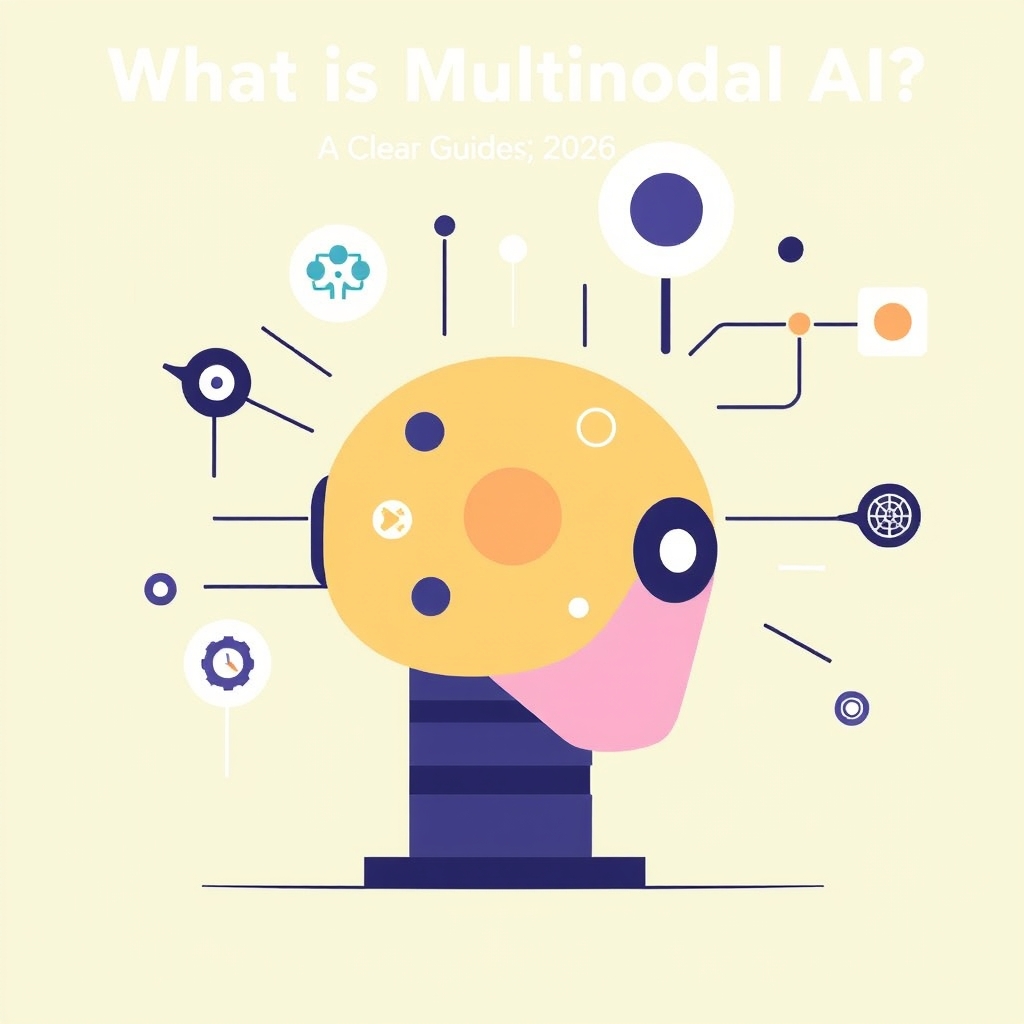
“Multimodal AI refers to systems that can process and reason across multiple types of information at the same time, such as text, images, audio, and video. Unlike older AI tools locked to a single format, multimodal models understand how different inputs relate to each other. This makes them dramatically more useful in real-world situations where information rarely arrives in just one form.”
Most of us experience the world through a mix of senses — we read a caption while looking at a photo, or we listen to someone speak while watching their face. Multimodal AI works the same way. It is an AI system that can take in, understand, and generate content across more than one type of data, called modalities. Those modalities typically include text, images, audio, video, and even structured data like spreadsheets. For most of AI's history, models were unimodal — a language model read text, an image classifier looked at pictures, and a speech recognizer processed audio. Each lived in its own lane. Multimodal AI breaks down those walls. A multimodal model can look at a photograph of a broken pipe and answer your question about how to fix it, or watch a short video clip and write a detailed summary of what happened. Think of it like the difference between texting a friend versus having a face-to-face conversation. A text exchange is unimodal — just words. A real conversation layers in tone of voice, facial expressions, and gestures. Multimodal AI is the step toward that richer, more natural kind of interaction, and it is quickly becoming the standard for cutting-edge AI systems.
How It Works
At a high level, multimodal AI works by converting different types of input into a shared mathematical space where they can be compared and reasoned about together. Each modality — say, an image and a sentence — gets processed by its own encoder, a specialized component that transforms raw data into numerical representations called embeddings. The key innovation is that these embeddings are designed to live in the same space, so the model can understand that a photo of a dog and the word 'dog' are closely related concepts. Many modern multimodal systems are built on top of large language models (LLMs), which serve as a kind of reasoning backbone. Visual inputs, for example, are broken into patches and processed by a vision encoder before being projected into the language model's space as if they were tokens, the same building blocks the model uses for text. The language model then reasons over everything together. This approach, used in models like GPT-4o and Google's Gemini, lets one unified model handle conversations that seamlessly mix text and images. Training a multimodal model requires enormous datasets that pair different modalities together — millions of images with captions, videos with transcripts, audio recordings with text, and so on. The model learns correlations between modalities through techniques like contrastive learning, where it is trained to recognize that matching pairs of image and text are more similar to each other than random mismatched pairs. CLIP, an influential model from OpenAI, popularized this approach and helped lay the groundwork for the multimodal systems we use today.
trending_upWhy It Matters
The world does not communicate in a single format, and increasingly neither does AI. Multimodal AI matters because it closes the gap between how humans naturally share information and how machines can process it. A doctor describing a patient's scan, an engineer annotating a technical diagram, or a teacher walking through a visual lesson — all of these involve mixing modalities in ways that a text-only AI simply cannot handle well. Multimodal systems make AI genuinely useful across medicine, education, design, customer support, and scientific research. Without multimodal AI, developers would need to stitch together separate specialized models and manage the awkward handoffs between them, losing context and accuracy at every step. With a unified multimodal system, the reasoning stays intact across inputs. This is why every major AI lab — OpenAI, Google DeepMind, Anthropic, Meta — has made multimodal capability a central pillar of their flagship models. The question is no longer whether AI should be multimodal, but how capable and reliable those systems can become.
Real-World Examples
- GPT-4o by OpenAI accepts text, images, and audio in the same conversation, allowing users to photograph a math problem and get a step-by-step solution, or speak naturally and receive spoken replies — all through one seamless interface.
- Google Gemini is deeply integrated into Google products and can analyze screenshots, PDFs, and videos alongside text queries, enabling tasks like extracting data from a scanned receipt or summarizing a YouTube video by watching it directly.
- Meta's ImageBind, a research model released in 2023, demonstrated binding across six modalities at once — images, text, audio, depth, thermal, and IMU sensor data — pointing toward AI that can understand physical environments the way robots or AR systems need to.
- Medical AI tools like those built on Microsoft's BiomedCLIP combine clinical text records with radiology images to assist radiologists in flagging anomalies, showing how multimodal reasoning can accelerate diagnosis in high-stakes settings.
FAQ
Is multimodal AI the same as AGI?expand_more
Do I need a special device to use multimodal AI?expand_more
What is the difference between multimodal AI and a chatbot?expand_more
Are there privacy concerns with multimodal AI?expand_more
Related Terms
This explainer was AI-generated based on publicly available information and may not reflect the most recent developments. For the latest details, consult the sources below.