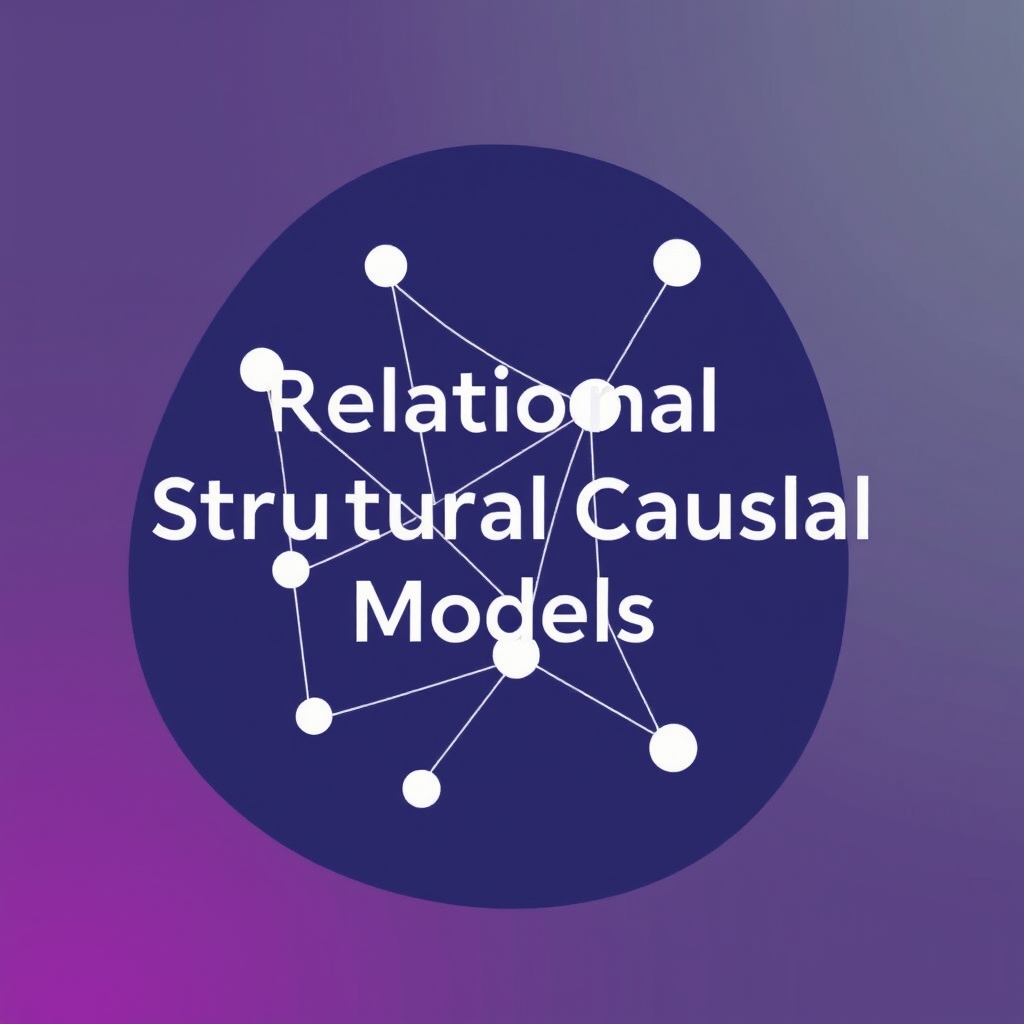
“Researchers have developed relational structural causal models that extend Pearl's causal framework to handle varying objects and relationships. This advancement allows AI systems to perform causal reasoning and counterfactual thinking while generalizing to unseen scenarios, addressing two critical challenges in building more robust and adaptable AI systems.”
Key Takeaways
- New framework extends structural causal models to handle variable objects and relations in environments.
- Enables AI to reason about interventions and counterfactuals with combinatorial generalization capabilities.
- Formally studies when and how causal models can be learned from relational data.
New framework enables AI to learn causal models that generalize across object combinations.
trending_upWhy It Matters
Building AI systems that understand causality is fundamental to creating more reliable and interpretable AI. This research bridges causal reasoning with relational learning, enabling AI to generalize beyond training scenarios—crucial for real-world applications where new object combinations constantly emerge. Success here could accelerate development of AI systems that reason more like humans.
FAQ
How does this differ from standard causal models?
Traditional structural causal models assume fixed variables, while relational models handle dynamic environments with varying objects and relationships, enabling better generalization.
What practical applications could this enable?
Potential applications include robotics, autonomous systems, and scientific reasoning where AI needs to understand cause-effect relationships across diverse scenarios with different entities.