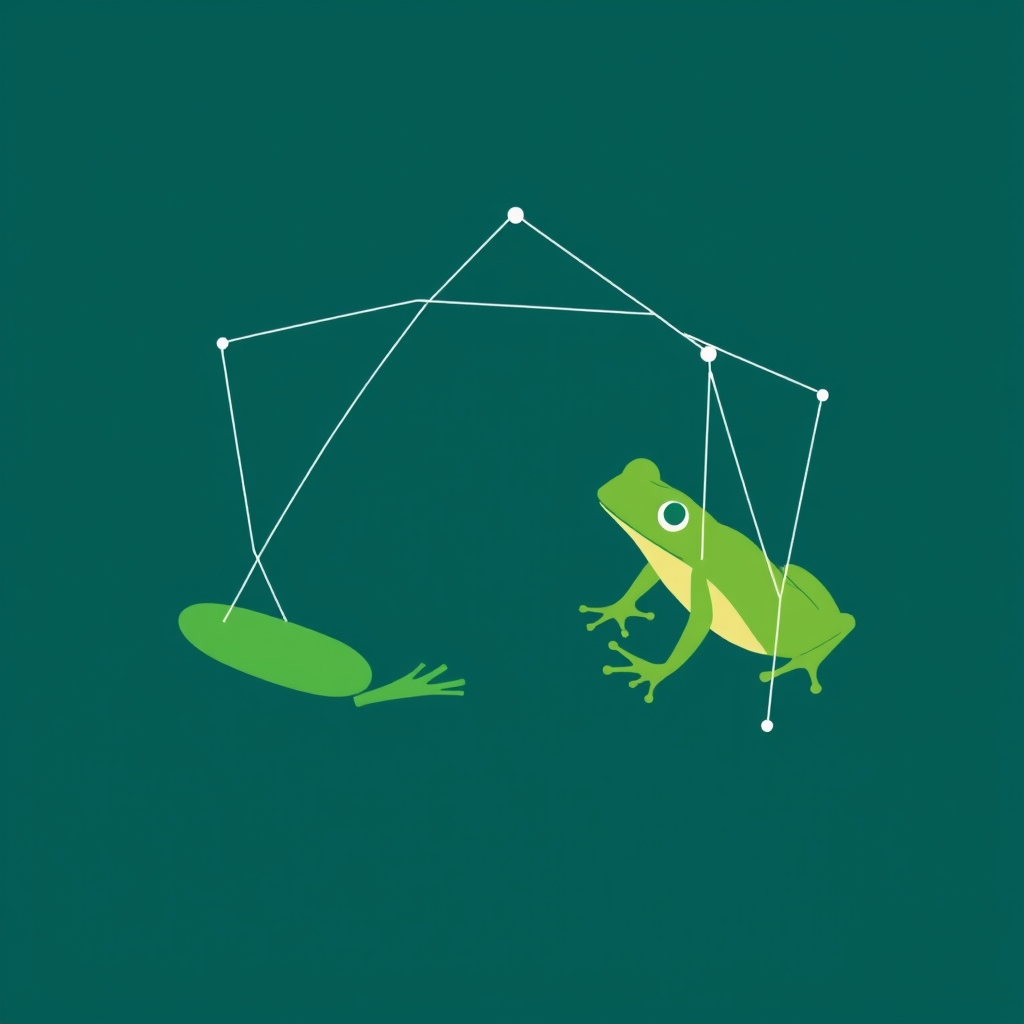
“Scientists developed Quantum Frog, a two-player cooperative game with a unique quantized-time mechanic where the environment only progresses when players act. Using reinforcement learning analysis, the research explores how game difficulty scaling and cooperation emerge in AI agents, offering insights into multi-agent learning dynamics.”
Key Takeaways
- Quantum Frog uses quantized-time mechanics where environment advances only on player actions
- Two-player cooperative game requires frogs to cross 8×8 grid while navigating traffic together
- RL analysis examines difficulty scaling and emergent cooperation in multi-agent systems
Researchers introduce Quantum Frog, a novel game testing how AI agents learn cooperation.
trending_upWhy It Matters
This research advances understanding of how AI agents learn to cooperate in complex environments. By studying emergent cooperation through game design, researchers can better understand multi-agent reinforcement learning dynamics and improve collaborative AI systems. The quantized-time mechanic offers a novel framework for testing AI coordination under controlled conditions.
FAQ
What makes Quantum Frog different from traditional cooperative games?
Quantum Frog introduces a quantized-time mechanic where the game environment only advances when a player acts, creating a unique coordination challenge for AI agents.
Why is studying cooperation in games important for AI development?
Game-based environments provide controlled settings to study how AI agents learn collaborative strategies, insights applicable to real-world multi-agent systems and coordination problems.